Non profit doesn't necessitate open sourcing their whole product. If you don't like that, don't donate. As long as they are transparent about their decisions that is the only obligation they have.
Perhaps it shouldn't necessitate it, but I can't think of a good reason why not.
If it were expensive to release it, that would be a reason. But it costs roughly zero dollars to create a public repo on GitHub and a cron job to push to it once a day.
Making the system public potentially increases the likelihood of a hack, which would be bad for Signal users. But relying on this argument to keep the source secret is, I think, a confession that your security is below par. Or to put it the other way round: A secure software system remains secure even if its source code is public, so making your source public is a strong signal that you are confident in your security measures. Security isn't something I expect all non-profits to focus on, but I think it would be telling for Signal to hide behind this reason.
1. A for-profit company rationally doesn't want competitors launching products using their code. Why would a non-profit care at all?
2. An app like Signal depends completely on network effects, so there's even less motivation for a community-fragmenting fork than in most OSS cases, where you'll notice that forks are already rare. There would have to be something very weird or contentious happening with the original codebase for people to want to fork it -- otherwise it's in no one's interests.
> Non profit doesn't necessitate open sourcing their whole product. If you don't like that, don't donate. As long as they are transparent about their decisions that is the only obligation they have.
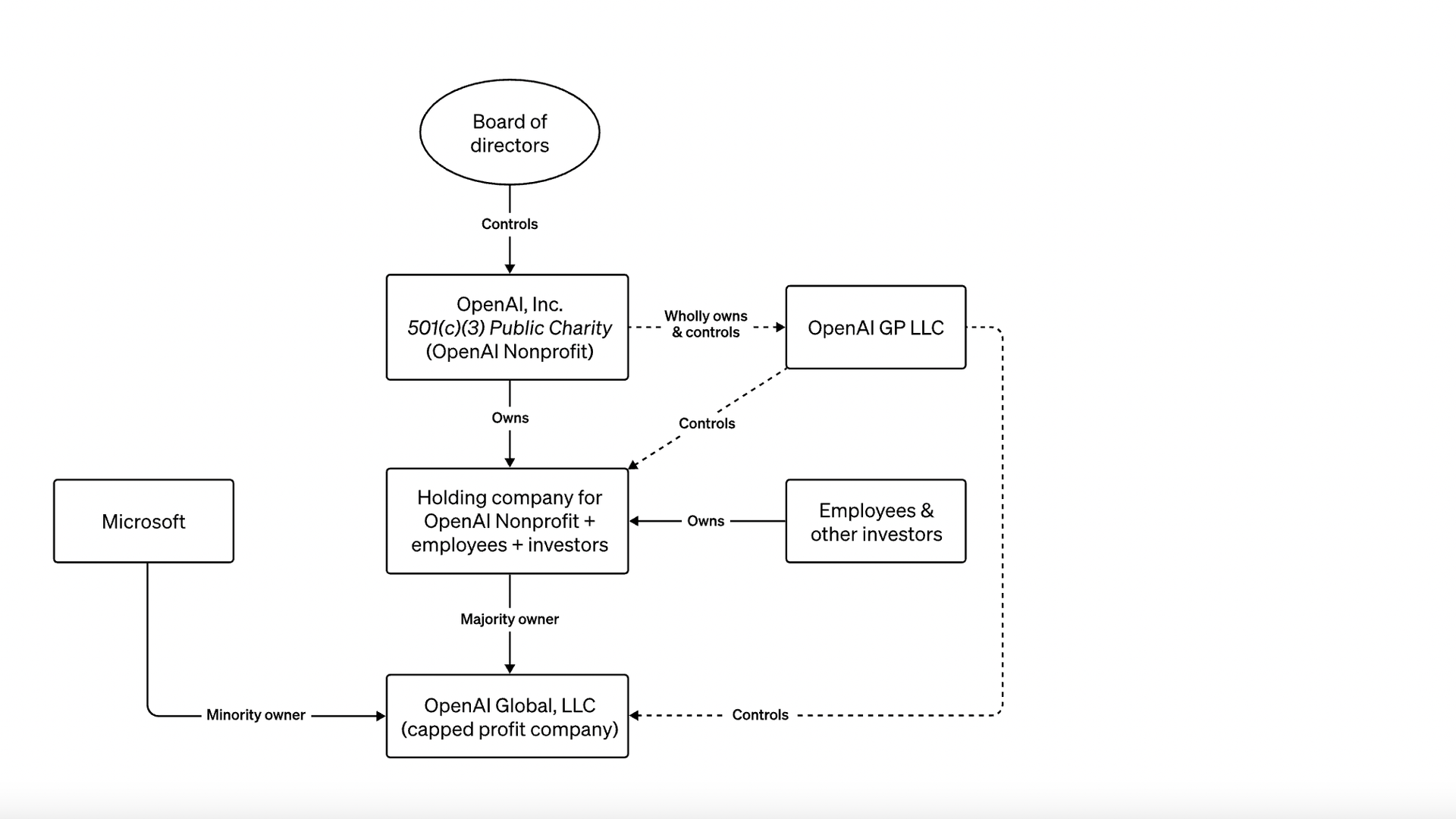
Actually you're mistaken. Under the 501(c)(3) tax code rules, they are required to act in the public good. Nobody has sued them to enforce this though, but I'd at least like them to acknowledge the game they're playing by ghosting us all on this.
American 501c3 law is extremely lax compared to analogous structures in the EU. A number of 501c3s are run as sinecures where a board (self-selecting, so no input from the membership) just hires its friends for well-paid positions that involve little work. Because the law is so lax and permissive, making a case that a given org is not acting in the public good is extremely rare and uphill.
OpenAI is a 501c4 not a 501c3. Also the structure is much more complicated for OpenAI.
Nevertheless the point stands - I don’t see what relationship company organizational mission has with their technical responsibilities. Indeed, if the open sourced everything, standing up a clone would be easier which creates funding risk due to a race to the bottom of people who didn’t invest into the R&D investing very little additional to compete.
'Apple' was a metaphor to Newton. 'Open'AI was meant as a promise; one that they've since broke both to some of their founders as well to the general populace. Reminding people of that broken promise doesn't seem that wild.
> According to Wozniak, Jobs proposed the name “Apple Computer” when he had just come back from Robert Friedland's All-One Farm in Oregon. Jobs told Walter Isaacson that he was "on one of my fruitarian diets," when he conceived of the name and thought "it sounded fun, spirited and not intimidating ... plus, it would get us ahead of Atari in the phone book."
> So you can, in fact, get better performance sometimes by applying some variant of "assume this problem is solvable" or "other problems like this were already solved by AIs" pep talk. Not always, far from it, but it does happen on the occasion with frontier capabilities.
Not OP. That’s not implied at all. The fancy autocomplete produces statistically likely continuations to the source text (the context window). For a problem that’s hard for humans one likely continuation is: “this is hard, can’t do”, even though there’s enough in the training corpus of the LLM to actually do it.
So, it follows that adding “pep talk” into the context window reduces the statistical probability of “no, can’t do” coming out as the answer you get.
These things are neither humans, nor deterministic software.
It doesn't explain why it doesn't make "I'm not paid enough for this shit" more statistically likely.
LLMs' processing that reproduces statistical patterns of the training data is modified by post-training. That's why we have LLMisms, for example.
LLMs aren't simple patter-matchers/pattern-predictors. They are incredibly complex systems that capture some aspects of the systems that produce the training data.
Maybe it does. Need to run evals to see if it does or doesn’t.
Point was - everything in the context window affects the output. Including “silly” things like “it is known AI can do this”. And that has nothing to do with superstition, as the poster above me seemed to imply.
That makes you very out of step with most Americans. You choose to pick on the obese because it’s more socially acceptable, but also people with cancer, kidney disease, etc.
Your position would be considered deeply immoral by most people (rightly). Maybe spend less time on-line and interact with regular people.


reply