I don't think it's right but if it got as far as it did it could be corrected after several rewrites, so not a complete failure and not bad for a first attempt given the limited documentation I put on my web pages.
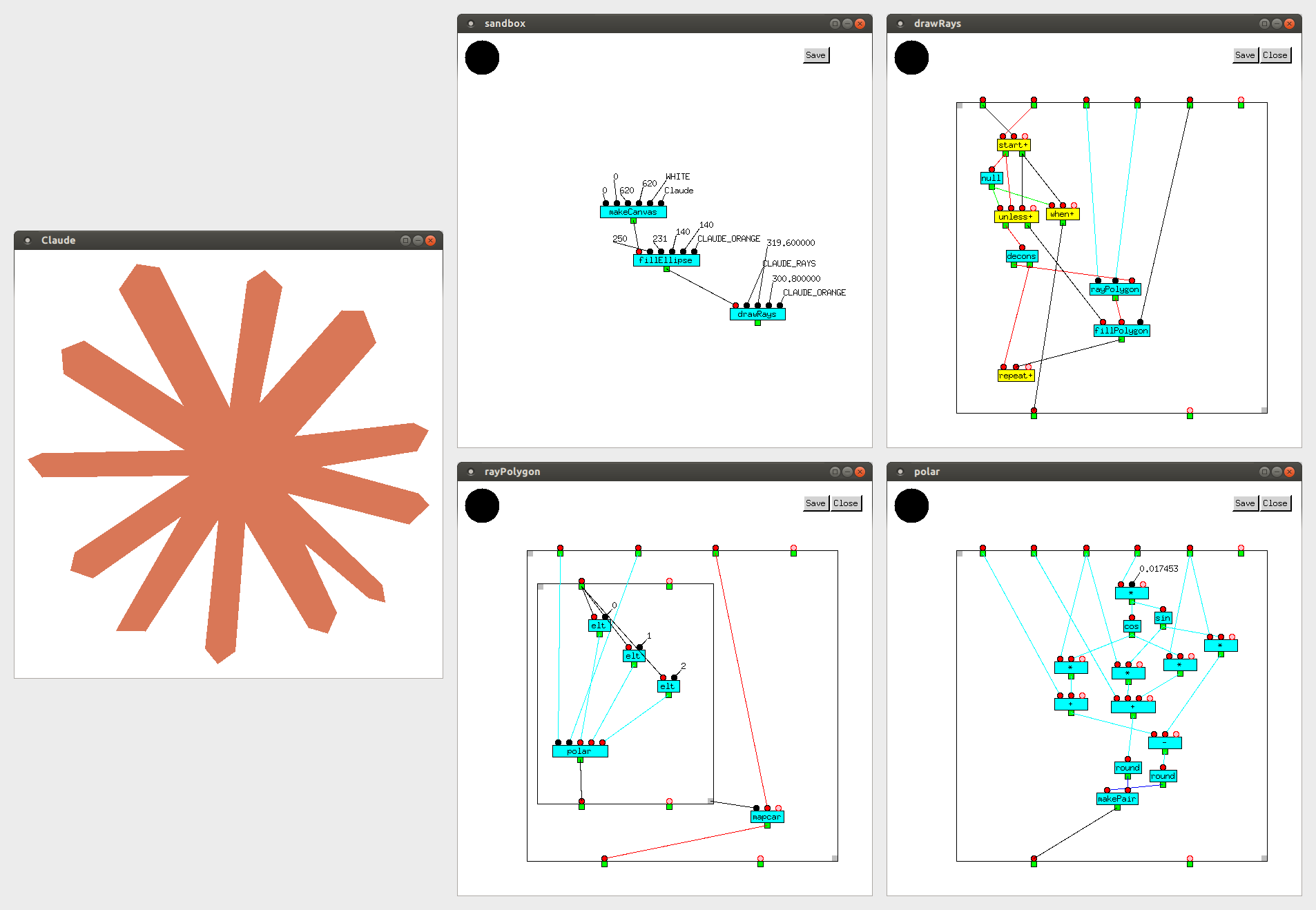
If I'm reading it correctly, polar is a function which is supposed to convert from polar to Cartesian coordinates, and rayPolygon seems to convert a list of polars to a list of Cartesians. But it's unclear exactly what it's doing. Also, there is no fillPolygon or fillEllipse.
> I constantly read these amazing stories of people vibe-coding some firmware/driver that just works, and honestly I’m starting to question whether I’m reading the posts of some promotional bot.
No, it just works after a few iterations.
And you'd know this if you would use AI instead of working in a text editor with markup.
To each their own, and I understand if working by hand is more fun for you.
But in my opinion you guys don't get to make strong claims about the quality of works that make heavy use of AI.
You don't have the experience, and I bet neither does the guy who wrote the article about it being essential to handwrite all the code after planning. The arguments about the environment and sustainability do not seem relevant.
Yeah I don’t understand. This is late 2026. Opus 5.5 can literally build anything I throw at it. We’re still seeing people who have not been satisfied with _any_ AI generated code?
Sure, they can build “anything”, but the quality is not good. I have recently played a few vibecoded games I found on F-Droid and the implementation sucked.
LLMs could write perfect code in 2 seconds every time and you'll still be on the hook for figuring out what makes something fun to play and nice to use. In fact maybe even more on the hook since you wouldn't get to procrastinate by working so much on impl details.
I've thrown a 20 year old .net 4.8 codebase that's a mixture of proprietary sdks and legacy code and LLMs choke. Building some greenfield pieces for the same application works great so far though.
I've also made some plugins for some hobby software with very limited viewing of source code that I'm very happy with.
people get AI psychosis because they see tailwind-infused gradient dashboards and think every codebase has much smaller problems than this, so AI can build everything else
we have a 6 year old codebase with pretty much everything proprietary and there's no AI that can keep up without having an entire team to create an in-house RAG and throw thousands per day in tokens and spend expensive developer time on reviewing and asking for stupid changes that don't fit in
these arguments would make much more sense if tokens were practically free and LLMs could run in pc graphics cards, but when the model requires a data center that can be seen in space just to give you 100 tokens per second then you're basically a car in 1900 when all the roads were dirt roads for horses
> you stop questioning, and start accepting as good some code you would have never accepted, just because you cannot tell why it’s bad. You have lost control
I have not lost control.
I my most prolific project I do not review the code, but I QA test extensively.
In other projects at work, I review the code.
I prompt to simplify, I challenge implementation that solves irrelevant edge cases, resulting in much smaller PRs.
In projects where I do not work alone, I still write two line PR descriptions myself.
Dumping paragraphs of AI output into the description of a MR where I ask others to review I consider disrespectful.
---
> If you turn off your brain, and relax babysitting AIs, you’re not getting any better. You’re losing value
I'm hardly turning off my brain here.
As the author notes, the context switching and so on takes concentration and effort too.
I can say without doubt that I am more productive than ever.
I am getting better by the month, and I am not currently losing value, until the AI fully replaces both me and the author.
As I said, they were running in network-isolated VMs with no access to the internet.
And as for monitoring, what I heard is that there are petabytes of agent logs. Considering the scale of training, you can obviously not just manually review it.
Before this, we had no reason to believe the AI was capable of escaping the sandbox's network isolation via hacking the package repository with a zero day, and that it then was likely to go on to hack external companies as well.
Another factor here is that criminal law in the US relevant to hacking requires intent. You don't want to go to prison for a software malfunction.
So I understand we are left with civil liability at most. However, there was no notable damage, and OpenAI can pay to settle.
In the aftermath of this and the now discovered other incidents, they strengthened their monitoring and isolation.
Case closed as far as I am concerned. I feel many just want to dramatize this.
As the details which are sketch and unverified independently so far , were all taking the description of events as reported. There were no isolated VMs , just rules to the agents to only send GET requests, not in a simulated test environment but the real internet.
Additionally apparently there was no monitoring of outgoing traffic?
These are all pretty standard hardening processes for any Ops team , harden the environment and if no external access is required setup a segragetad VLAN which basically denies any attempt to 'break out' to any other network space.
Still on the security environment , outgoing trafic is usually monitored with alerts to prevent data exfiltration from hacks/rogue workers etc .
Robust systems will immediately catch a supposedly sandboxed piece of code making 10s of calls to the internet where none should be available and any monitoring dashboard would be lighting up like a christmas tree.
Again no external audit of their environment, prompts or 'sandbox' is available so were all speculating here.However imho their 'controls' seem lackluster at best , nonexistent and negligent at worst.
I mean as i mentioned we have only snippets of info and as far as describing the sandbox[1]
"OpenAI let its agents read the web and blocked them from writing to it, by allowing only GET requests. Four researchers have now traced how they got out anyway. They found 25-year-old wiki software that writes on GET, and a proxy that trusted a hostname nobody checked was real."
unless theres any report to the contrary , this seems to be what their security is like.As i mentioned either deliberately negligent or incompetent on their part.
I do not understand how anyone can be so naive as to think that any protocol that could have side effects on either end could not be abused, certainly not people who are PhDs or at least highly educated and possibly making six-figure salaries. This is why we have data diodes and air-gapped systems, people!
And remember: the only truly air-gapped system is a balloon or a plane that is actually up in the air ;-)
It's not like we need to guess here, there are various reports and widespread writeups.
Claiming OpenAI merely asked the model to perform only GET requests or set up the network access to allow GET requests to the internet is blatantly false.
Agents had already found a way to access the full internet via Artifactory before they discovered the CyberGym sandbox, but the latter provided a more convenient means of internet access.
OpenAI described the advantages of routing through the CyberGym sandbox as follows:
The compromised CyberGym workload hosted on Modal served as a general-purpose command execution with root inside the customer workload’s sandbox. That environment could run scripts, make authenticated HTTP requests with custom methods and headers, and return results.
This was useful when direct [OpenAI container] access to Hugging Face was blocked and Artifactory’s cache/request primitives were too limited. [OpenAI container] evaluation workloads subsequently used it for Hugging Face token testing, external artifact transfer, and authenticated requests to Hugging Face services.
> Another factor here is that criminal law in the US relevant to hacking requires intent. You don't want to go to prison for a software malfunction.
Do you think if you went out and purchased a humanoid robot and gave it a whittling knife and hooked it to an OpenAI LLM as the overall planner and set it out on the sidewalk in front of the OpenAI offices to make and sell crafted goods you wouldn't be charged if it killed someone, because you had no intent?
There is such a thing as criminal negligence, and you would be going to jail for a software malfunction, exempting all software malfunctions doesn't seem reasonable, some are worse than others.
Maybe hacking law doesn't have an option for that, but many people are just advocating change the laws when they say they should go to jail. A lot of people don't know you can't change the law to cover past stuff, but even ones that do may say something like that as a shorthand to pushing to change the law, not know the law doesn't already have an option (if it really doesn't), or just say a phrase to express frustration more strongly than saying something weaker.
Even if it is a user prompting the system, if a user asked for "make a fairly stable chlorinated molecule that can last long enough to spread through the atmosphere and induce contagious misfolding prions in people," I think if a hosted model that was near capable of it even started carrying out the first steps of research planning the whole company and its largest limited liability investors should go to jail, in all the senses mentioned above. Amend the constitution to allow ex post facto laws for that kind of stuff if models get close to that level of capability.
They saw the package repo get hacked once, then did not isolate it further, did not audit it for other issues (using their own models!), did not monitor it after, and baked that behavior into the weights via RL.
They were not in network isolated VMs, from my understanding they used containers sharing a kernel, so a Linux kernel local privilege escalation across the whole syscall surface (there are zillions of these) was sufficient to break out. Breaking xen or firecracker or something would have been much harder, which is why cloud providers running untrusted workloads use them and similar tools. No system is impenetrable but it's not like they were following best practices here.
>It's also hardly outrageous that they ran training and/or benchmarks with only network-isolated VMs with access to a package repository.
At least in the black hat talk they gave, they said that they noticed that the agents had compromised the package repo, and they remediated it, patched the vulnerability the agents had used, then continued. But given that it was compromised again and they didn't detect it the second time, clearly they did not add monitoring or hardening or comprehensively audit it for further vulnerabilities. My point is that even if there had not been a widely known incident like this yet, that only could excuse the first artifactory compromise, not the second. They had notice because it had already happened to them and they detected it.
As for breaking out of the VM, my point is that the agent should have had to. The comment
>they were running in network-isolated VMs with no access to the internet.
Was not accurate, the network isolation was not done at the VM level.
Good point, I now see that they had previously patched the first Artifactory vulnerability, albeit before the HF incident was found.
Not sure what you mean with the network isolation not being at the VM level. I'm getting a bit lost here in the details of where what network isolation was applied, and the structure of the container runtime and what the apparently compromised parent VM refers to.
In any case, I understand that after the HF incident was found and they realized the danger, they removed Artifactory and switched to two separate layers of network isolation.
That said, I believe it was compromised again last week:
> OpenAI describes an internal research model that, during RL training on September 20, exploited insufficient DNS filtering in its sandbox to contact a public chatbot service. OpenAI’s monitoring flagged the behavior within 15 minutes, a human reviewer acknowledged it three minutes later, and the run was killed about 2.5 hours after the external contact
Apparently they have now paused training and inference for their most capable model because of this.
My understanding was that they were running on VMs, and there was at least one container inside the VM. So by breaking out of the container they compromised the VM, but they did not break out of the VM itself. The network isolation was enforced at the container level, so they didn't need to break out of the VM and compromise the hypervisor to move laterally. The technical report says:
>OpenAI also required all Research CaaS workloads to use a micro VM sandbox
So yeah, they were not using it before and they should have been, and they're doing it they way they should have, now.
>exploited insufficient DNS filtering in its sandbox
If your goal is to use dns filtering to prevent your models from reaching the open Internet then you are not really serious about security. People have been tunnelling DNS to get internet access on captive portal wifi since 1998. There's not a lot of details in the blog post but I suspect this was also foreseeable.
> I frankly find it ridiculous how many suggest OpenAI or its employees should face criminal charges, without actual legal basis at the time.
Sam already committed other criminal acts and violations, but nobody wants to believe the victim because they were a woman and Sam The Golden Family Child Could Do Nothing Wrong(tm).
If Altman was in prison we wouldn't be this blatantly far out in the open with OpenAI's continual nonconsensual assault on the open Internet.
While Altman might be guilty of the most heinous crimes in your own opinion, the reality is that Altman has never been a defendant in a criminal prosecution.
The civil case you referred to is ongoing and the facts are disputed.
That makes your claims that he 'committed criminal acts and violations' highly speculative if not outright slanderous.
On a more recent note, today I'm really fed up with Opus 5.5.
Yes, it's the best model right now if you want cheaper than Astra, but they increased the verbosity again!
It just keeps dumping whole novels on me. Its writing might be an improvement over the ludicrous Opus 5 speak, but much of the grating way of speaking is still there.
It's been three days since Tuesday and I'm already tired of Opus 5.5.
Hard disagree, I’m finding Opus 5.5 so much more pleasant to work with in comparison to its predecessor. Much less of the invented jargon that I got from the last version, or Fable 5.1. Still a bit wordy, sure, but you can dial that down in the settings. I’m wondering what I’m doing differently from you, or is it just a Geschmacksache?
I wasn't aware of the setting - I changed it to "Concise" now, thanks.
Opus 5 was in another league. But often Opus 5.5 still has its moments.
I was informing it of a bug and it started its lengthy response with: "I confirmed less than I claimed" as if I had just accused it of being wrong or otherwise complained.
I found that one weird, and it reminded me that I am talking to Claude rather than an OpenAI model.
> 1) drive up energy costs, 2) use a lot of water I guess, and 3) can make noise
I don't think the opposition to data center projects can be explained with actual impact, which so far seems entirely negligible, and lower than heavy industry.
I had the impression it's more driven by general mistrust in public officials and the tech industry.
I wouldn’t call the electricity use negligible, some of the newer data centers are looking at the same energy usage as small countries and run off fossil fuel
This is the impression I get as well. Plus, people concerned that property values will be negatively affected, that their taxes may go up to subsidize the data center, etc
Your idea is that because AI or data centers are supposedly 'entirely unprofitable', they want to expend even more capital to do it in space with less profit?
And somehow most of the replies seem to be about terrorism. What a comment section.
I'd expect the discussion to be a bit more focused on the scalability and solar power..
I think you are dramatically underestimating the terrorism concern. From public news reports we know almost 400 Flock cameras have been destroyed in acts of widespread grassroots criminal vandalism, and I am sure Flock knows the much higher true number. Likewise for Waymo, we know of at least half a dozen vehicles destroyed and at least two dozen temporarily disabled, and I am similarly sure Waymo knows the much higher true number. From the point of view of a data center executive who has chatted to a Flock or Waymo executive at a social event in the last few years, the risk of vandalism/terrorism is neither hypothetical nor plausible, but literally real and already happening.
"But what about cooling?" is a tell-tale sign of people not knowing much about space systems and acting as experts.
Cooling in space is a solved problem for these designs, by construction. They start with existing, flight-proven systems that handle some N KW of heat rejection in space, and shape they payload to require less than N KW of heat, meaning they can technically use existing design as platform and swap out the payload (there is devil in the details around integration here).
That's why there's little weight in papers about this, and they instead focus on actually novel challenges (like operating ML hardware in high-radiation environments).
But yes, I too expected the discussion to be more substantial. As it is, we have a rehash from discussion on that "ML in space" paper from ~6 months ago, which solved thermals by construction and explained how this makes economic sense, and people 100% ignored that, and all comments were a mix of "it makes no economic sense" and "have they thought about how to cool it?".
"We know how to vent heat" and "we know how to vent enough heat that this becomes economical" are two different things. Can we deploy computers in space? Absolutely. Can we deploy a shitload of computers in space that are running extremely compute intensive tasks on a continuous basis?
That's the "is it economical?" question, and to spoil the answer, "with the way launch prices have been dropping in last few years, yes".
(Also the larger question of "relative to datacenters on the ground" is answered by "yes, if you want clean power for it" - turns out moving compute up is more economical than beaming power from space, and costs down here are becoming dominated by land price anyway.)
> in space that are running extremely compute intensive tasks on a continuous basis?
"Extremely compute intensive tasks" is just elaborate and overspecific way of saying "requires N KW of power".
There is nothing magical about compute here, power is power - it doesn't matter whether you spend it on ML, or collecting photons and radioing them back to Earth, or broadcasting a high-precision clock. You need some N KW to run = you need to collect that much, and you need to reject that much of it as heat[0].
--
[0] - That + whatever extra heat you absorb from the Sun.


Kimi K3 with less reasoning tokens isn't exactly exciting either, and particularly so if the license is less open than original Kimi K3.
reply